A face that has seen too much: the “Thousand-Yard Stare” phenomenon and the reality of modern trauma
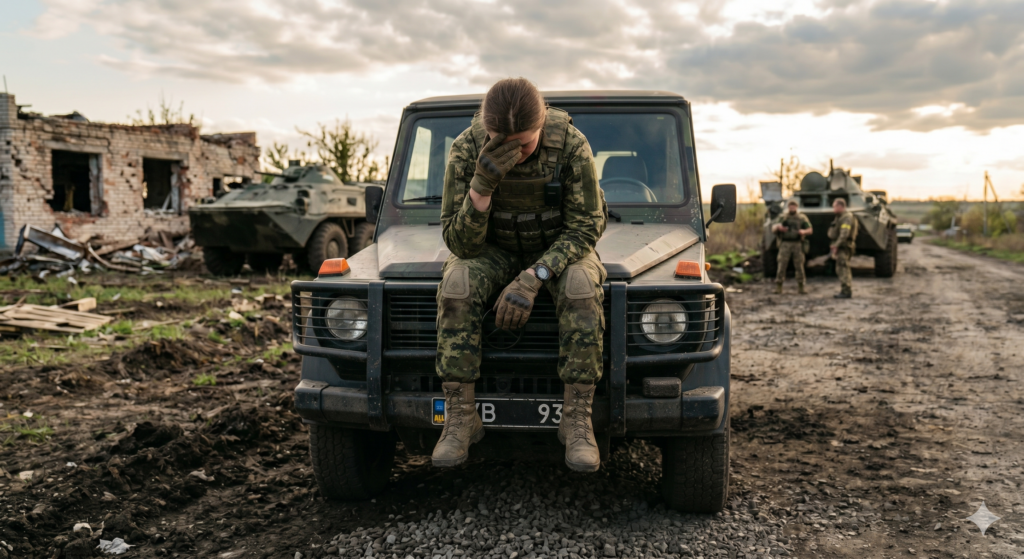
The war in Ukraine is not just a clash of technologies, but above all a crushing test of the human psyche. On the faces of many soldiers today there is an expression that history has known since the First World War, but which in the current conflict is taking on new, more frightening dimensions. It is the “Thousand-yard stare” – a state in which the eyes do not look at the world around them, but through it, fixed on a non-existent distance.
What happens in a soldier’s mind?
This empty gaze is not a sign of madness, but paradoxically a functional defence mechanism. The technical term is dissociation. When the human mind is exposed to “continuous traumatic stress” (CTS) – a state in which the danger never ends and the brain has no time to recover – it simply disconnects. It is the way the psyche survives artillery hell or the constant surveillance of lethal drones in isolation. The soldier is physically present, but his consciousness has withdrawn into a deep inner exile so as not to be torn apart by the horror of reality.
Why is Ukraine different from Afghanistan?
The latest studies from 2025 (e.g. in the journal Neuroscience Applied) emphasise that the intensity of trauma in Ukraine is many times higher than on missions in Afghanistan. The reasons are:
- No rotation: The soldier’s brain is in “fight-or-flight” mode for months on end. This leads to burnout and irreversible changes in the limbic system.
- “Drone hypervigilance”: The feeling that a lethal drone can strike you anytime and anywhere makes deep sleep impossible – and deep sleep is key to processing trauma.
- Artillery shell shock: Constant blasts from explosions cause physical micro-injuries to the brain, which add up with psychological trauma to form complex PTSD (C-PTSD).
Our moral responsibility
The thousand-yard stare is a silent cry for help. We must not allow this temporary state of “disconnection” to turn into a final resignation from life. Supporting veterans is not charity, it is our moral debt. If we as a society fail in empathy and in building systems of care, we will become complicit in the losses that will come after the war.
The history of Vietnam, where subsequent veteran suicides (over 100,000 victims) exceeded the losses on the battlefield, must serve as a warning. Our task is to make sure that empty gaze has somewhere to return to – to respect, to family and to hope. If we look away, veterans will lose the last point connecting them to the civilian world.