Jon Mark Cunningham
U.S. Air Force veteran
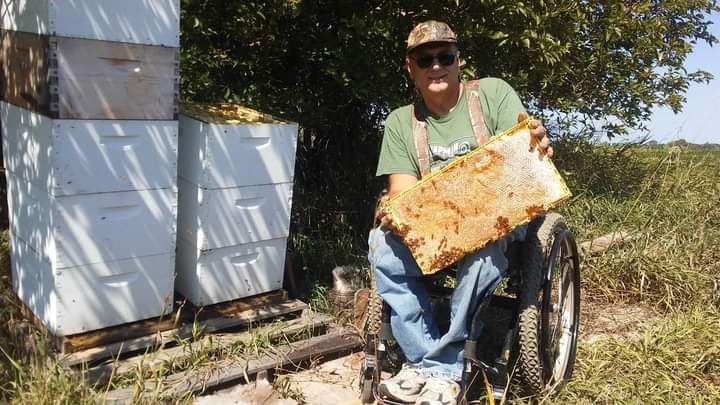
I started beekeeping in 1981, when I worked for one of the largest beekeeping companies in the country.
In 1997 I had an accident that left me paralysed and in a wheelchair.
But I still loved bees, being outdoors and nature. So I bought a few hives and started my own small business: “Papa Mark’s Honey Farm”. So now I have my own local honey and I sell it.
I’m telling you this because in most of my photos with bees I wear very little or no protective gear at all.
I don’t recommend it to anyone and I would NEVER advise anyone to do it!
My personal rule is to let the bees tell me how much clothing to put on.
Being in a wheelchair means it takes me forever to squeeze into a bee suit, no matter what I’m doing.
I don’t make fun of beekeepers who suit up. On the contrary, as a mentor I insist that new beekeepers wear a suit.
I also have two suits for friends and family who sometimes like to come and watch.
But for me personally, suits just aren’t necessary.
Jon is currently preparing his whole story for us together with his family.
Beekeeping with a disability is not just about technical adaptations.
It is about freedom of movement and of mind.
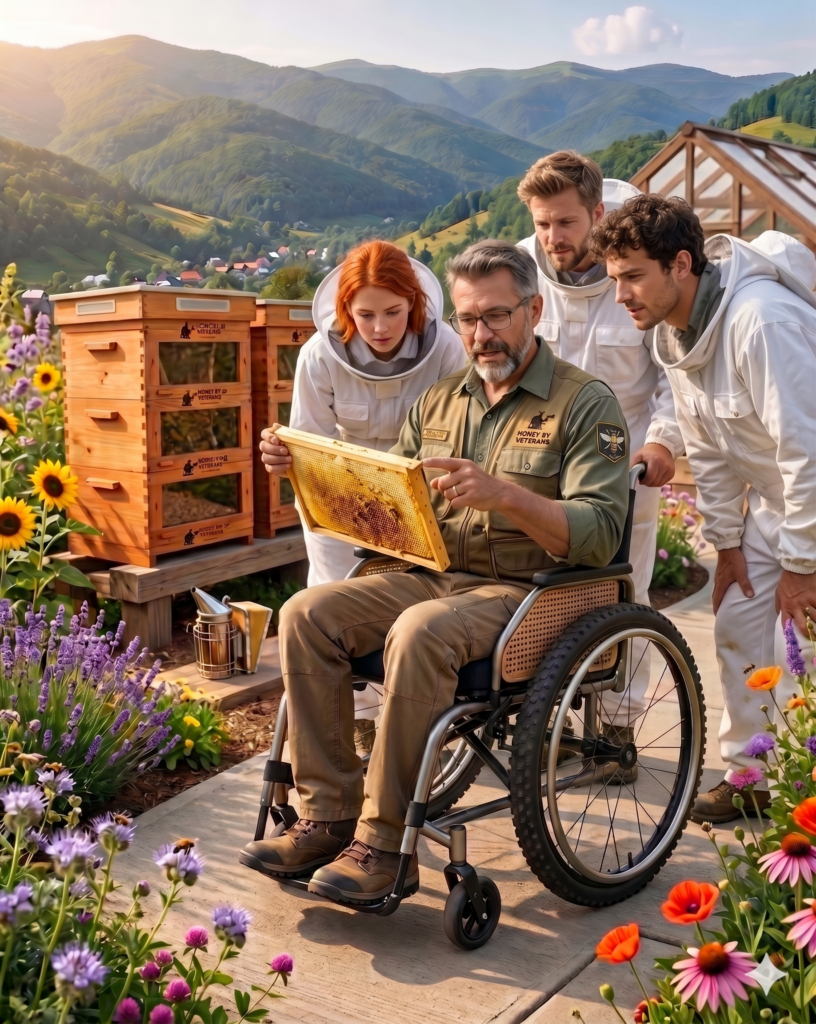
The main difference from standard beekeeping lies in the ergo-physical strategy. While an ordinary beekeeper naturally bends over the hive, handles boxes at different heights and uses their mobility for quick corrections of movement, a beekeeper in a wheelchair has to “architect” the apiary. Hives must be positioned so that their entrances and interior are reachable without unnatural leaning back or strenuous twisting of the torso. This often means using horizontal (“ležan”) hives, where you work on a single level, or special stands that allow the wheelchair to roll right under the hive.
What a beekeeper in a wheelchair has to cope with most is the genius loci of the terrain. The site where the hives stand is rarely friendly to wheelchair wheels. The beekeeper must therefore invest effort in preparing barrier-free facilities – paved surfaces, access ramps and careful placement of hives that eliminates the need to manoeuvre on grass or soft ground. This “beekeeping engineering” is a necessary initial investment that protects the beekeeper from sudden complications during the main season.
The psychological aspect of this hobby is also specific. Beekeeping requires calm and composure, because bees react sensitively to vibrations and sudden movements. For a beekeeper in a wheelchair, working with bees becomes training in absolute control over one’s own body and smoothness of movement. Where another beekeeper might use strength to loosen a frame glued with propolis, a wheelchair user has to use precise technique and leverage. Every action becomes a conscious decision, which leads to a deeper understanding of the bee community.
The biggest challenge remains physical fatigue and limited reach. Beekeeping is a seasonal, intensive activity. The beekeeper has to learn to work efficiently, divide work into smaller time blocks and often look for ways to mechanise lifting frames or honey supers. It is a hobby that requires not only a love of nature, but also the ability to accept that some things will not go “the traditional way”.
Beekeeping from a wheelchair is proof that a passion for bees knows no physical barriers. It is a path that requires more planning, more adaptation of the environment and more technical creativity, but the reward – the sweet smell of honey and the calm buzzing of bees on a summer afternoon – is the same for every beekeeper. Wheelchair users who take up beekeeping often find that their “different approach” is in fact a very effective and innovative way to become an integral part of the natural world.